
STATEMENT BY ATYAŃ EZEM
13 October 2026
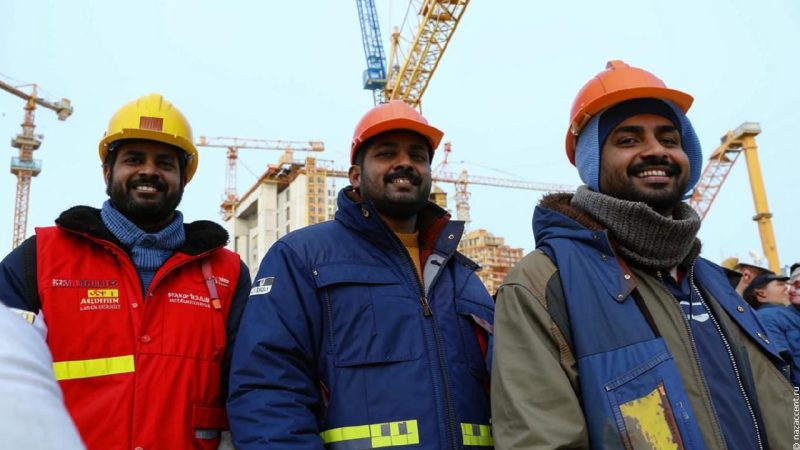
In 2026, the authorities of the Republic of Mordovia raised the quota for foreign workers from 147 in 2025 to 854. After cuts in October, 578 slots remain — still nearly four times the 2025 figure. Two-thirds of them have been earmarked for citizens of India. At the same time, the republic’s tripartite labour commission instructed the Ministry of Social Protection and the Ministry of Internal Affairs to “calculate” the share of foreigners in the republic’s workforce — implementing a federal directive on “working with compatriots and foreigners who share Russian spiritual and moral values.” The contents of this procedure have not been disclosed to the public.
Behind the figures and the bureaucratic language lies a strategic choice made by the centre in Moscow. While schools, clinics, clubs and houses of culture are being shut down in Erzyan, Mokshan and Tatar villages; while bus routes are being cut and healthcare, education, utilities and local infrastructure are left to decay; while the young people of our indigenous peoples are pushed out of the region in search of work and a future — the vacancies and the social gaps left behind are being filled by labour migrants from Central and South Asia, brought in by large employers, dozens and hundreds at a time.
This is not a coincidence. It is a single policy with two faces. Money flows from our land to Moscow. In return, our schools and hospitals are closed, and our villages empty out. That empty space is filled by workers who are not taught our languages and can be paid less.
Two parties benefit: metropolitan capital, which needs cheap labour it can keep without rights, and the central state in Moscow, which finds it easier to govern a population with no roots and no language of its own than living Erzyans, Mokshans, Tatars and Russians.
Everyone else loses. The indigenous peoples lose, because language and life drain out of our villages. The region’s Russian workers lose, because their wages are pushed down. And the new arrivals lose: they are brought here not for their own future, but as temporary hands — without rights, and without any real chance of becoming part of this land.
Erźań Mastor is not a colony and not a reservoir of cheap labour. It is the land of the Erzyans, Mokshans, Tatars, Russians and other peoples who have lived here for generations. Any migration policy on this territory must proceed from their interests — not from the needs of big capital and the federal centre.
The current policy is a tool of assimilationist pressure. Importing hundreds and thousands of workers under no obligation to learn Erzyan or Mokshan, and with no stake in the culture or life of the region, is not “integration.” It is a mechanism for dissolving the indigenous peoples. What the policy of closing national schools failed to finish, demographic engineering is finishing now.
The root of the problem lies in the economy, not in the migrants. As long as the republic’s revenues flow to Moscow; as long as the social infrastructure of our villages is dismantled; as long as our young people have no work and no prospects at home — any “labour shortage” will be met by importing people from outside. The only honest way out is to restore to the republic control of its own budget, its own economy, and its own social policy.
Therefore we demand:
- An immediate halt to the issuance of work permits to foreign nationals on the lands of Erźań Mastor — until the republic’s social infrastructure has been restored, until decent employment for local residents has been secured, and until migration policy has been brought into line with the interests of the region’s indigenous peoples.
- A full public account from the republic’s authorities: on whose request and in whose interest the quota was raised from 147 to 854 slots; which specific enterprises are drawing in this labour, and through what budgetary and infrastructural decisions.
- An immediate end to the dismantling of social infrastructure in Erzyan, Mokshan and Tatar villages: the closure of schools, clinics, clubs and houses of culture, and the gutting of transport and municipal services.
- The return to the republic of its own revenues, and of the right to determine its own social, economic and migration policy.
- Mandatory teaching of Erzyan and Mokshan in every school of the region — including for the children of those who come here to live and to work. If someone comes to this land to make a life here, they are obliged to learn its languages and to respect its peoples. If they are brought here temporarily and stripped of rights, as a mere working tool, that is a crime — against them and against our land.
Erźań Mastor belongs to the Erzyans, Mokshans, Tatars, Russians and other peoples who have lived on this land for generations. We have no quarrel with those whom metropolitan capital brings to our land — but neither do we intend to surrender our land, our language or our future. It falls to us to keep this land ours, and to see that those to whom it belongs decide for themselves who comes here to live and work, and on what terms.
Vejsë, erźat, vijevťano! — Together, Erzyans, we are strong!
Atyań Ezem
